The Kinopolis was redesigned as a unified acoustic system to ensure clear and reliable speech transmission in a highly reflective, open space.


Introduction & Project Overview
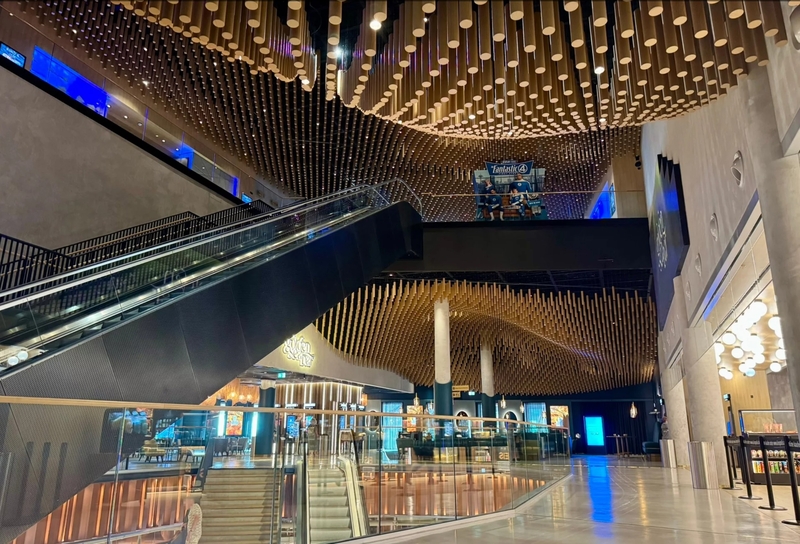
The Westfield Überseequartier in Hamburg represents one of Europe’s most ambitious mixed-use developments, integrating retail, leisure, hospitality, office, and residential areas within the heart of the HafenCity. Among the highlights of this project, the Kinopolis multiplex cinema stands out as a cultural focal point. It features ten theaters with more than 2,300 seats and a spacious multi-level foyer that includes restaurant areas designed as a lively social hub.
Ensuring high-quality acoustics in this kind of environment goes far beyond comfort; it is essential for effective speech transmission—vital for visitor guidance, operational announcements, and emergency communication. Clear and reliable speech transmission is therefore not merely a comfort feature but a core safety requirement under DIN VDE 0833-4. With thousands of visitors each day, numerous restaurants, and open connections between floors, Melanie Ziska from SAVE audio solutions faced a considerable challenge: achieving uniform and intelligible sound in a space dominated by reflective materials such as glass, concrete, and aluminum, combined with open vertical couplings.
Initial Scope and System-Wide Reassessment
The original planning scope focused exclusively on the cinema levels (2nd to 4th floor). The 1st floor (1st floor), which houses the Food Court and main circulation areas, was initially not part of the assignment. However, early analysis revealed that this separation was not acoustically viable.
Due to the open architectural layout—large vertical openings, open staircases, and strong acoustic coupling between floors—sound energy propagates freely across levels. As a result, local acoustic measures or isolated loudspeaker concepts would inevitably influence adjacent floors. Based on this assessment, Melanie Ziska concluded that the entire foyer had to be treated as one coherent acoustic system, rather than as independent zones.
This realization fundamentally expanded the scope and directly influenced all subsequent design decisions.
Evaluation of the Existing Installation
At the time of engagement, a loudspeaker system had already been partially installed. Before proposing any modifications, SAVE audio solutions carried out a simulation-based evaluation of the existing setup using EASE 5.
The “as-built” condition was reconstructed and analyzed with respect to:
- Speech Transmission Index (STI),
- sound pressure level distribution,
- interaction between floors,
- and compliance with DIN VDE 0833-4.
The results were unambiguous: the existing system failed to meet the required STI threshold of ≥ 0.50. Several loudspeakers were acoustically shadowed by structural elements, others were ineffective due to excessive mounting distances, and in some areas the sheer number of sound sources increased diffusivity and reduced intelligibility.
These findings were presented to the client in a transparent and simulation-backed manner. As a direct consequence, a strategic decision was made:
- the existing installation was fully dismantled,
- with the sole exception of the 4th floor, where the basic concept was acoustically viable and could be upgraded by adding further loudspeakers rather than replacing the entire system.


Challenge
Architectural and Acoustic Challenges
The Kinopolis foyer combines visually striking architecture with extremely challenging acoustic conditions. The dominant surfaces—exposed concrete, glass façades, metal elements, and the iconic aluminum “wave” ceiling formed by approximately 5,000 fins—are largely reflective and generate complex reflection patterns.
Key challenges included:
- Large room volume of approximately 18,480 m³ with strongly varying local reverberation behavior,
- Vertical acoustic coupling between 1st floor and 4th floor, amplifying reflections and echo build-up,
- Smoke curtains that subdivide the space in emergency scenarios and can partially or fully shadow loudspeakers, requiring proof of intelligibility both in raised and lowered states,
- Extensive HVAC ducts and open technical installations, particularly in 1st floor, severely restricting mounting positions,
- Very limited room-acoustic treatment, especially in the Food Court,
- High and dynamically changing background noise levels, with evacuation scenarios involving up to approximately 1,700 people.
A particularly critical aspect was 1st floor: here, no dedicated room-acoustic measures were planned. This means that the audience itself becomes the primary absorbing element, making system performance highly occupancy-dependent.
Project Execution & Results
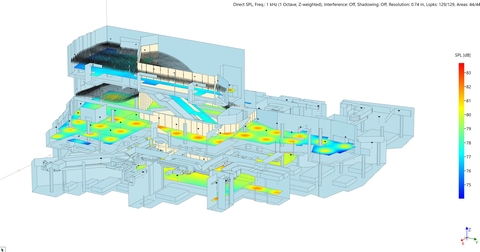
To reliably address these conditions, SAVE audio solutions developed a detailed, high-resolution 3D model of the entire foyer using EASE 5 with the AURA module. The model was based on IFC data, architectural plans, and extensive on-site photo documentation.
Special attention was paid to elements often simplified or ignored in conventional models:
- smoke curtains in both operational states,
- ventilation ducts and cable trays,
- stair openings and voids,
- furniture zones and audience absorption.
Multiple scenarios were simulated, including:
- empty space,
- partial occupancy,
- full occupancy,
- emergency operation,
- and defined fault cases (Havariefall) in line with DIN VDE 0833-4.
Because of the highly non-uniform distribution of absorption, classical Sabine or Eyring models were intentionally avoided. Instead, AURA-based hybrid ray tracing was used to calculate spatially resolved impulse responses, enabling realistic predictions of reverberation time, SPL distribution, and STI across thousands of receiver points.
Loudspeaker Concept and System Design
The final loudspeaker concept was entirely derived from simulation results and developed iteratively.
- 1st floor (Food Court / Core)
Ceiling-mounted loudspeakers were largely ineffective due to smoke curtains and HVAC obstructions. Sound projectors were therefore positioned around ceiling openings to cover shadow zones, supplemented by wall-mounted loudspeakers where required. Narrow-beam A/B speakers were deliberately avoided, as simulations showed that they increased diffusivity and reduced STI in this highly reflective space. - 2nd floor and 3rd floor
Existing ceiling speakers were replaced by high-output spherical loudspeakers to reduce coverage distances. In areas beneath the aluminum fin ceiling, pendant loudspeakers were positioned close to the listening plane. Narrow, acoustically isolated zones created by smoke curtains were addressed using horizontally mounted column loudspeakers with carefully controlled directivity. - 4th floor
The existing concept was retained but expanded with additional loudspeakers to improve uniformity and coverage of stair openings. This was the only level where components from the original installation were partially reused.
Across all floors, delay times were precisely aligned, with the 4th floor defined as the temporal reference. The frequency filtering was designed to specifically support speech intelligibility. The focus was on the mid and high frequency components that are essential for speech transmission, particularly in the range from 1 to 4 kHz. Low-frequency signal components were reduced by high-pass filters, as they contribute only to a limited extent to speech comprehension but can unnecessarily excite the room. At the same time, more power reserves are retained on the amplifier side in order to specifically support the frequency ranges that are important for speech transmission.
Results & Validation
The simulation-based verification confirmed that the redesigned loudspeaker system meets the requirements of DIN VDE 0833-4 across all evaluated operating scenarios, including emergency operation and defined fault conditions.
Speech intelligibility (STI) targets were achieved on all levels despite the highly reflective architecture and the strong acoustic coupling between floors:
- On the 1st floor (Food Court), average occupied STI values of approximately 0.52 were achieved. This is particularly noteworthy given the absence of dedicated room-acoustic measures and the dominance of hard surfaces. Under fault conditions, STI values remained at or above 0.47, maintaining normative compliance.
- On the 2nd and 3rd floors, STI values increased to approximately 0.56–0.57 due to shorter listening distances and more controlled loudspeaker placement.
- On the 4th floor, STI values of around 0.55 were achieved, including in areas adjacent to stair openings.
Simulations further confirmed that lowered smoke curtains do not result in critical intelligibility losses, provided the system is operated with the designed loudspeaker positions, delays, and filters.
Sound pressure level distribution showed a high degree of uniformity:
- Broadband direct SPL values typically ranged between 78 and 80 dB in relevant listening areas.
- Level variations across the listening plane were generally limited to ±2 dB, with only minor local deviations near ducts or stair voids.
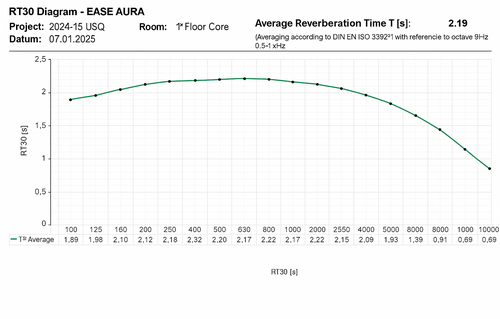
Reverberation behavior remained strongly dependent on occupancy. On the 1st floor, simulated RT30 values ranged from approximately 1.8–2.4 s in the empty condition and reduced to 1.2–1.4 s when occupied. The results underline the importance of audience absorption in the Food Court area, where no room-acoustic treatment is present.
Overall, the results demonstrate that the redesigned system provides reliable and uniform speech intelligibility, even under challenging architectural and operational conditions. At the same time, the simulations highlight that additional room-acoustic measures - particularly on the 1st floor - would further improve robustness in low-occupancy or commissioning scenarios.
Conclusion
This project demonstrates how simulation-driven acoustic design and careful loudspeaker planning can reconcile complex architectural ambitions with stringent safety requirements across the entire complex. By treating the building as an integrated acoustic system rather than a collection of isolated areas, it was possible to achieve compliant speech intelligibility while maintaining the architectural design and visual integrity of the spaces.
The final system design provides a uniform and intelligible sound field that fulfills all emergency communication requirements (STI ≥ 0.50), even under elevated background noise levels of approximately 75 dB LAeq. At the same time, the design contributes to improved visitor comfort through controlled sound distribution and reduced echo effects, while remaining adaptable for potential future changes in layout or occupancy patterns.
However, the results also highlight an inherent limitation in areas such as the Food Court, where architectural surfaces remain highly reflective and room-acoustic treatment is minimal. In these zones, system performance depends strongly on audience absorption. Although the current configuration achieves normative intelligibility in the simulation, additional acoustic treatment is recommended to increase robustness, particularly during low-occupancy conditions or commissioning phases when the beneficial absorption provided by visitors is absent.
It should also be noted that the system configuration was implemented according to the simulation results. However, the commissioning of the system was not part of the SAVE audio solutions contractual scope. A final on-site verification measurement of the installed system has not yet been carried out.