EASE to IMMI workflow: Bridging sound system design and environmental noise assessment via the APS model

Planning an open-air concert or festival is a delicate balancing act. Event organizers and sound engineers strive for powerful, dynamic audio coverage, while local authorities require adherence to noise immission regulations to protect neighboring communities. These two applications have different goals and speak different languages which impedes exchanging information and risks severe misunderstandings.
Electro-acoustic design relies on the complex interaction of coherent sound sources, capturing intricate phase relationships, electronic beam steering, and frequency-dependent directivity. On the other hand, standardized environmental noise propagation models and regulations (such as ISO 9613-2, TA Lärm, and CNOSSOS-EU) are centered around power-based analysis of incoherent point sources with simple directivity. The focus of the first is on prediction accuracy for the audience zones close to the stage, whereas the focus of the second is on worst-case prognoses for immission points away from the concert’s area.
The Aggregate Point Source model (APS) solves this problem by seamlessly translating information between these two applications.
Collaborative industry research and validation
The theoretical foundation and empirical validation of the APS model are the result of a cross-disciplinary joint research initiative with expertise across the entire acoustic chain. To bring the new solution to life, AFMG collaborated closely with Wölfel Engineering, the creators of the IMMI noise immission software, loudspeaker manufacturer TW AUDIO, and the environmental noise experts of Akustik Bureau Dresden.

Jointly presented across several papers at recent AES and DAGA conventions, this research lays the foundation for a standardized framework that allows translating the model of a sound system that is composed of groups of coherent sources into a set of highly accurate substitute point sources which aligns with the mathematical expectations of environmental noise software.
The theoretical framework
The core of the APS model lies in identifying internally coherent subsets within a comprehensive sound reinforcement system (e.g., a discrete flown line array or a ground-stacked subwoofer array). While the elements within these subsets interact coherently, the discrete subsets themselves are largely incoherent relative to one another.
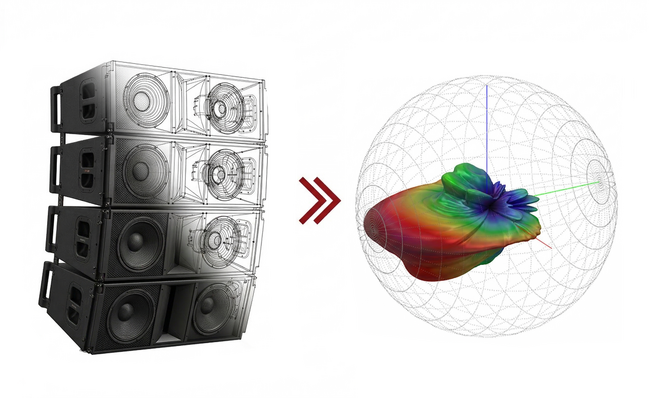
In EASE 5, the Complex Directivity Point Source (CDPS) model is utilized to calculate the directivity pattern of these coherent subsets in high resolution. The APS export computes the far-field directional transfer function Γ(θ, r) for each subset, applying spatial smoothing (at a 5° resolution) and spectral smoothing (in 1/3rd octave bands from 25 Hz to 20 kHz).
By extracting the magnitude-only directivity data and establishing an absolute reference level (normalized to a defined near-field position), the APS model allows each array to be treated mathematically as a single, highly accurate, incoherent point source within IMMI. This ensures compliance with ISO 9613-2 propagation algorithms without sacrificing the electro-acoustic directivity profile.
Far-field transition and low-frequency validation
A primary concern addressed during the research phase was the behavior of low-frequency arrays (25 Hz to 160 Hz). Measurements of several types of subwoofer arrays demonstrated the practical accuracy of the CDPS model and that far-field conditions are reliably met at typical immission evaluation distances. This applies also to sub arrays with delay-steering as well as the use of subwoofers with cardioid directivity patterns. When imported into IMMI, the APS model successfully replicated the directional characteristics of such configurations, including on-axis focusing effects and deep rear cancellation.
The first validated, standards-compliant workflow
The APS model has been rigorously validated against extensive monitoring data from live concerts at large urban open-air venues. During studies at the Rinne festival area in Dresden, featuring audiences of up to 70,000 people and coverage zones of up to 300 m × 250 m, the new solution was successfully applied for complex deployments including Clair i5/CO12, d&b GSL/KSL, and L-Acoustics K1/K2 systems.
At immission points up to 1 000 meters from the stage, the APS model yielded an average absolute deviation of just 1.5 to 3 dB across the 25 Hz to 4 kHz spectrum. By comparison, simple omnidirectional point-source approximations yielded deviations exceeding 8 dB. While meteorological factors, such as downwind propagation, turbulence, and temperature gradients, remain a variable in any ISO 9613-2 calculation, the base emission data provided by the APS model eliminates the primary source of error.
How it works in EASE 5.81
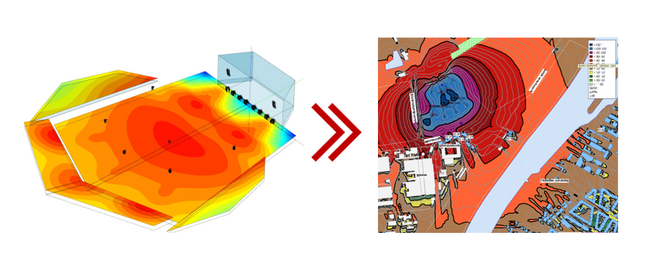
Creating a standards-compliant noise forecast is now a streamlined part of the system design process:
- Design your system: The sound system is modeled in EASE, including loudspeaker positioning and aiming, configuring mechanical details such as the line array splay angles, as well as setting up the EQ and further signal processing.
- Define parameters: The user defines the internally coherent groups (e.g., Main L, Main R, Sub Array) and assigns a reference location (e.g., FOH) to calibrate the absolute sound pressure level against a targeted program spectrum (e.g., TA Lärm "Rock/Pop" curves).
- Export data: EASE compiles the far-field balloons, absolute SPL references, and 3D spatial coordinates into the .aps format.
- Import to IMMI: The .aps file is imported directly into IMMI, where it interacts with 3D topographical models, ground impedance data, and shielding obstacles to generate a standards-compliant immission map and point calculation.
Just like that, by utilizing the APS workflow, acoustic consultants and system engineers can now align their methodologies. EASE 5.81 and IMMI 2026 provide a deterministic, theoretically and practically validated pathway to accurately predict, assess, and document environmental noise immission for complex open-air events.
Next steps & resources
Ready to integrate standard-compliant noise immission predictions into your acoustic design workflow?
- EASE 5 Trial – Experience the APS export functionality firsthand with a free trial of EASE 5.81.
- Learn about IMMI – Explore the advanced environmental modelling capabilities of IMMI at Wölfel Engineering.
Access the research: Review research that forms the foundation of the APS model:
[1]: Feistel, S., Blaul, J., Goldmann, T., and Nicht, A. (2024). Sound immission modeling of open-air sound systems. Audio Engineering Society 157th Convention, New York, NY, USA.
[2]: Blaul, J., Feistel, S., Goldmann, T., and Nicht, A. (2025). Standard-Compliant Sound Immission Forecasts for Open-Air Music Events. DAGA 2025, Copenhagen, Denmark.
[3]: Goldmann, T., Feistel, S., Blaul, J., and Nicht, A. (2025). Modelling and Verification of Low-Frequency Sound Systems in the Application of Noise Predictions. Audio Engineering Society 159th Convention, Long Beach, CA, USA.


